
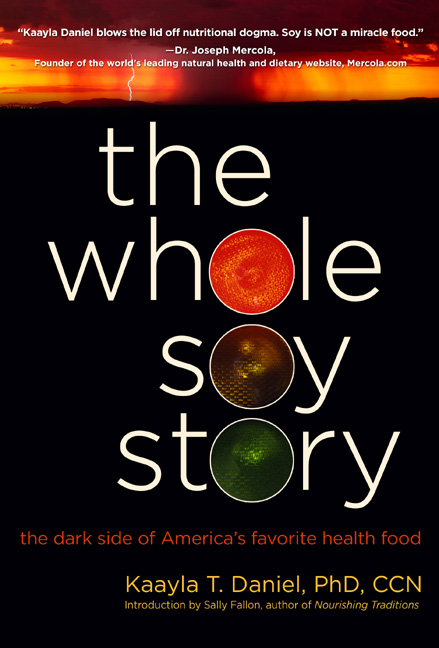
THE WHOLE SOY STORY – A SUMMARY
If you’ve ever wondered what the truths are behind the Soya image this has to be the most comprehensive dissection ever. Kaayla T. Daniel leaves no stone unturned in her quest to find an answer to the question, ‘Is Soya really a superfood?’ Two hundred million Americans alone are currently switched on to the so called benefits of this ancient bean.
Like a skilled surgeon the author feels her way around the body of contention, to reveal hundreds of epidemiological, clinical and laboratory studies link soy to malnutrition, digestive distress, thyroid dysfunction, cognitive decline, reproductive disorders, immune system breakdown, and even heart disease and cancer. The list is seemingly endless.
Daniel for example, looked very closely at a five-year clinical trial in which six out of 179 postmenopausal women taking a very high dosage (150 mg) of soy isoflavone supplement, developed endometrial hyperplasia. None of the 197 women who took a placebo did. “Endometrial proliferation is a precursor of cancer.”
The great thing is this leading light of the health food sector interprets the often contradictory evidence on soy and disease to reveal what studies are valid, which justify hope, which are nothing more than hype – and why. Daniel doesn’t just attempt to convince the reader of her own opinion on the subject. In fact I can’t remember seeing such an in depth and more comprehensive scientific and medical approach to a health food topic.
Her compact history of Soya is essential reading as she also reveals the food isn’t so widely enjoyed in Asia as the media would have you imagine. Brought to the West largely by trading missionaries its popularity grew quite quickly. Not surprisingly Hitler himself, saw the food as potentially powerful tool in his mission to build the perfect race.
The author makes a point of lifting the lid on the sensitive subject of ‘Frankenfoods’, soya being one! In fact the very name ‘Monsanto’ can send a shiver down the spine. She pulls no punches in looking at the way soya is processed in the modern world. One could argue this book reveals what both scientists and the soy industry have been trying to suppress in the continuing quest for big business. It can make for pretty serious reading.
‘Soy foods are processed using both high heat and pressure, but also with alkalis, acids and chemical solvents. The worrying thing is these second generation products are used in the health food sector. Others are known as junk foods! Is there really a difference?
‘Dried soy beans are inedible – so why would you want to eat something inedible? Even when soaked for hours the beans still need pressure cooking or boiling for up to a further nine hours. Even at this point some are still not mashable or soft enough to use!’
Did you know? Soy proteins are responsible for bulking up more than 60 percent of hamburger patties, spaghetti sauces, baked goods and other readymade supermarket products. It’s even a key ingredient in various canned tuna.
Antinutrients found in soya are put under the microscope from Phythates and lectins to saponins and oxalates. Daniel reveals how soy estrogens cause hormonal disfunction leading to a range of bodily malfunctions. Women in particular can be at great risk from the many side effects of soya as the earlier cancer study example highlighted!
The worrying rise of Soy allergens is talked about openly along with toxicity and its implications for everyone digesting this so – called food from the fountain of youth!
It’s fascinating to look at soy broken down into its different types. The reader is left in no doubt from milk to margarine, first generation products to the next; this bean has a profound effect on our world.
Daniel uses dark humour to add to this compelling reading: ‘Lisa, in an episode of the Simpsons approaches a vending machine for a snack, and chooses a ‘soy joy’ energy bar. The wrapper comes with the chilling message ‘now with gag suppressor’!
The author reveals when soy oil became a large part of Indian cooking, a very large number of Indians came down with ‘dropsy’. Worrying still is the fact 77 to 79 per cent of vegetable oils Americans consume comes from the soya bean. Even more telling is the fact those who promote soya as a wonder food tell people to stay away from the oil! Soy milk and associated products are shown to be particularly harmful when used long term, especially with infants in mind!
If you are a vegetarian not in the best of health and have begun questioning whether the meat without a bone is as good for you, then read Daniels’ thesis and think again! Tofu, when eaten in large amounts by people in middle age can actually lead to brain damage, for example!
In fairness the case for the defence is limited in the book, and of course there have to be some counter arguments. There are many studies out there taking the other side of the argument. But it’s rare to see such thorough research go into a lengthy analysis of one particular so called ‘health food’.
The upshot of all this would seem to be: Soya isn’t a miracle food at all, a panacea, or for this matter the answer to world hunger. Many of those on an exercise regime or keep fit drive have been seduced by the promoted benefits of soya products. Sadly, the real soy story would seem to blow all of those theories completely out of the water. Like so many things in our world, we’ve taken them and altered nature’s plan for pure profit. The analysis presented here flies in the face of the propaganda used to convince us all Soy is a superior food of both the present and future.
The author sheds light on the fact big business and big government has fuelled the promotion and processing of Soya. Because of this, whole soy foods that did contribute to health if eaten in moderation have fallen by the wayside. Now, new products can lead to both malnutrition and disease. The benefits of soya it would seem have been overtaken by billion dollar corporations and food processing plants, leading to pollution and ill health. In fact, adults self-medicating with soy to prevent cancer, heart disease or relieve menopausal symptoms are especially at risk.
Written intelligently with Authority, expertise and via painstaking research, this book is a must for everyone with both an open mind and a desire to get to the heart of the matter. This is in essence, ‘The Whole Soy Story’.
Darren Tyrie North East Personal Trainer and Biosignature Practitioner